New method for identifying "ecogames"
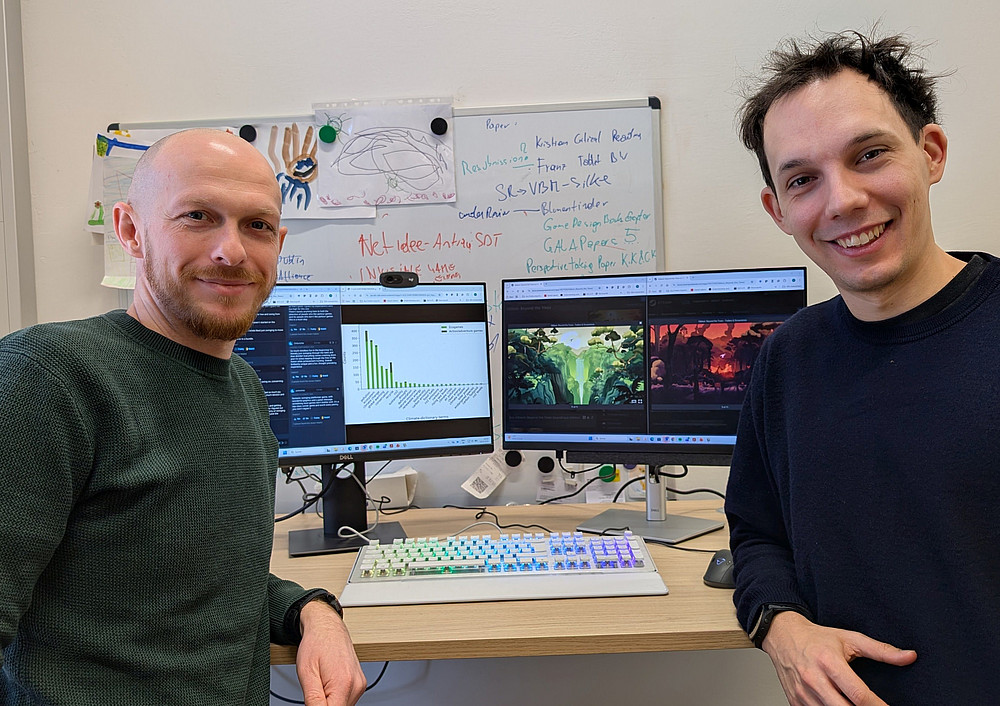
Moritz Edlinger and Manuel Ninaus from the Education Technologies Cluster used AI and large language models to find the proverbial needles in the haystack from a huge data set of online game ratings. They present the new method in their latest paper.
Around 10,000 new games are released every year on the online gaming platform Steam alone. A few of them have the potential to encourage players to adopt more sustainable behaviour by focusing on environmental and climate change issues. However, in order to be able to use these so-called eco-games specifically for research and school lessons, you first need to know how to track them down in the first place. "There is no specific labelling as an 'ecogame'," emphasises Moritz Edlinger. "Theoretically, ecogames can be found in any game genre."
Together with Manuel Ninaus, he has developed a method for pre-selecting promising eco-games, which the two recently presented in the study "Analysing Player Reviews with Natural Language Processing to Identify Ecogames for Education and Research" were published. They used natural language processing (NLP) and artificial intelligence (AI) to analyse over 186,000 player reviews on the online gaming platform Steam in order to identify games with climate-relevant content. "We utilise the collective intelligence of the players," explains Manuel Ninaus. "Only a very small proportion of reviews address sustainability - most of them relate to the gaming experience. The AI-based tools are necessary to find the 'signal in the noise'."
As part of the pre-selection, 45 ecogames and 45 action-adventure games were selected as a control group, whose game ratings were analysed using two NLP approaches. Pre-selection makes it possible to reduce the pool of games to a manageable number, which can then be used for laboratory tests or teaching.
The results of the study show that ecogames present environmental issues to varying degrees. The shorter games "Beecarbonize", "Alba: A Wildlife Adventure" and "Gibbon: Beyond the Trees" were identified as particularly promising for use in the classroom. The method developed proved its methodological feasibility.
It also acts as a proof of concept for how AI can be used to advance research - in areas where it would only be possible with enormous effort or not at all by humans. In addition, the concept is scalable and transferable to other topics such as diversity or growth mindset. "The study also served as a preliminary study for a planned laboratory study, which will then analyse the media effects," says Moritz Edlinger, who is currently working on his dissertation.