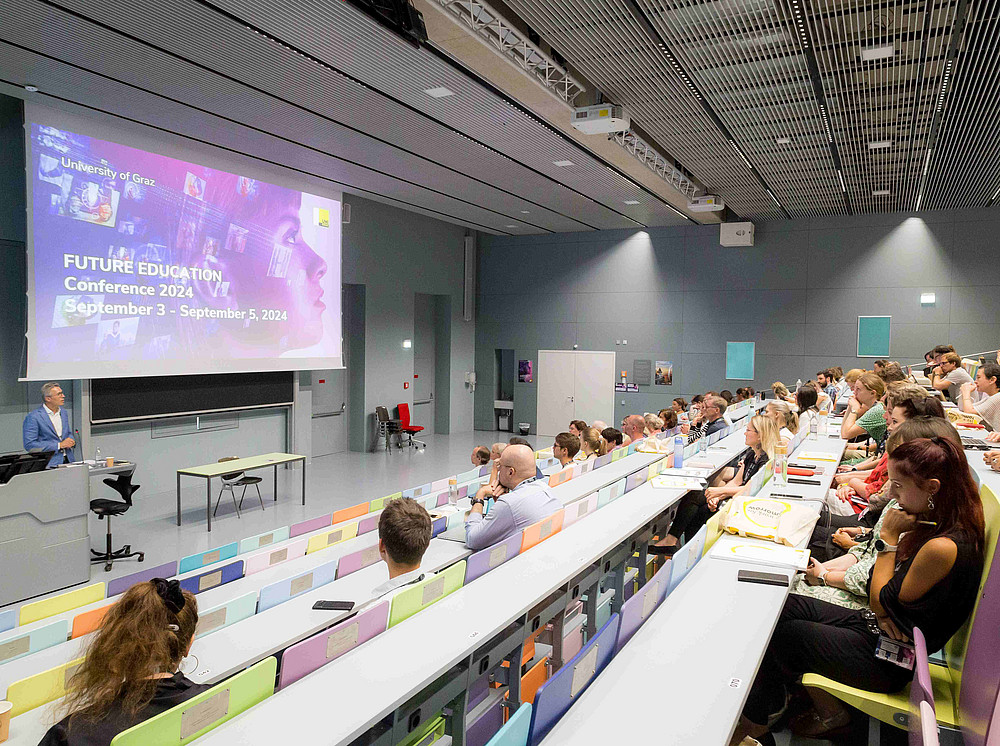
This interdisciplinary conference offers an inspiring framework for the presentation and discussion of current scientific work on the topics of education, learning, development and teaching. The focus of the conference is on interdisciplinary work that contributes to shaping the education of the future in such a way that learners can master current and future challenges well. The aim is to stimulate a social discourse on what a successful education of the future could look like.
A look back: The FUTURE EDUCATION Conference 2026
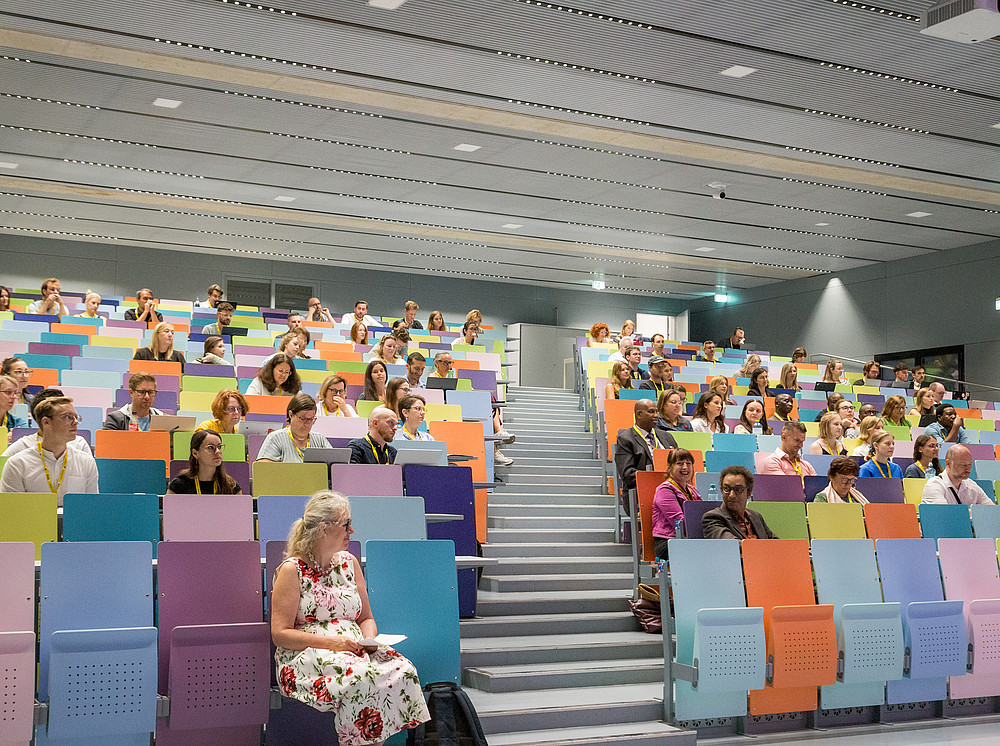
What happens when different disciplines come together to look at the future of education? Under the theme ‘Interdisciplinary Research Perspectives’, the FUTURE EDUCATION Conference 2026 at the University of Graz brought together 214 participants from 25 countries.
The FUTURE EDUCATION Early Career Award 2026 has been presented
The FUTURE EDUCATION Early Career Award was presented on 2 September 2026 as part of the FUTURE EDUCATION Conference. The award was presented to Hannah Deininger (University of Tübingen) and Heike Russ (University of Tübingen). We offer our warmest congratulations to both winners!

Symposium
Symposia offer the opportunity to present different research perspectives on a specific topic from different disciplinary angles. Each symposium comprises three speakers, one chair and one discussant. A 90-minute session is planned for each symposium, with 20 minutes of presentation time per talk and 10-15 minutes for the discussant's contribution.
Symposia must fulfil the two-country rule: Active participants (presenting author, chair and discussant) must come from at least two different countries. All active participants must have an FEC 2026 ConfTool account.
Research Lecture
A Research Lecture offers the opportunity to present and discuss current research findings in an interdisciplinary setting. Each presentation is given 20 minutes, followed by 10 minutes of discussion. The lectures are grouped thematically into 90-minute sessions with three presenters in each session.
Poster Gallery Walk
Posters offer researchers the opportunity to present their work in various visual formats. The poster session takes place as a 90-minute "Gallery Walk" and allows participants to immerse themselves in in-depth discussions about the research work presented. Posters will be presented in A0 portrait format (dimensions: 841 mm x 1189 mm).
Fostering critical thinking and creativity – a way to improve education
In his presentation, Stéphan Vincent-Lancrin first highlights how a focus on creativity and critical thinking prepares students for interdisciplinary education and benefits from interdisciplinary research. Drawing on an OECD project, he highlights how critical thinking and creativity can be fostered in teaching and learning whilst teaching traditional academic subjects. He demonstrates how this can be achieved without technology, whilst also showing how technology might either challenge or support this objective. He then reflects on the potential benefits this could bring to future education and what would be required to make it a reality.
Using Educational Technology to Facilitate and Enhance Science Education
Scientific reasoning encompasses pupils’ ability to use evidence to understand natural phenomena, formulate explanations for them, and evaluate claims. It involves forming hypotheses, designing and carrying out observations or experiments, analysing data, drawing conclusions, presenting arguments, and revising ideas based on empirical evidence. In my talk, I will illustrate how these processes can be enabled and facilitated using educational technology such as virtual experiments (simulations) to engage in (guided) scientific inquiry practices. The studies cited show how educational technology serves to augment (rather than replace) hands-on experiments; furthermore, they illustrate effective ways to support cognitive and metacognitive processes during scientific inquiry.
Language, Literacy and Learning to Read
Learning to read depends on children’s phonological skills and knowledge of letters, and measures of rapid naming ability are also correlated with reading fluency. Drawing on a longitudinal study of children at high risk of reading disorders, it is proposed that oral language forms the foundation of reading, yet its role has typically been underestimated in models of reading development. Data are presented highlighting both the direct and indirect impact of language skills beyond phonology on children’s reading outcomes. Findings are discussed within a multifactorial framework, and implications for interventions to promote reading and related educational skills are considered.
The Future of Games for Learning
Over the past two decades, research into games and learning has revealed how well-designed play can foster cognitive development, motivation and behavioural change across education, health and even the justice system. Yet as the world faces escalating disinformation, polarisation and social fragmentation, the field must evolve. This talk reflects on what we have learnt about how games cultivate thinking and skills – and argues that the next frontier lies in designing for shared understanding, critical discernment and civic imagination. Games for learning must now help rebuild the very social fabric that enables learning, trust and democracy itself.
The Future of Learning: Tailoring Educational Approaches to Individual Backgrounds
Talent development frameworks have typically been associated with supporting the most able learners in schools. However, to engage effectively in talent development, it is necessary to gain an understanding of learners’ current skills and competences and to help them progress to the next level. As we work towards making society more inclusive, an equitable talent development framework requires recognising and embracing the backgrounds of all students and creating educational environments in which they can all thrive. In this presentation, I will discuss psychological factors that demonstrate how to personalise learning experiences by addressing the unique cultural, social and cognitive influences that shape each student’s educational journey.