Spotlight on the teaching profession: Largest research project on students leaving higher education and the workforce launched
Under the title “Should I stay or should I go?”, Austria’s most comprehensive research project to date on a pressing educational policy issue was officially launched in Graz in March 2026. The project focuses on the conditions and processes surrounding students and teachers leaving their studies and careers – an issue that poses challenges for both universities and schools in light of the acute shortage of teachers. Barbara Weißenbacher, a member of the Plurality and Diversity Cluster, is leading the project together with Corinna Koschmieder from the University of Education Styria.
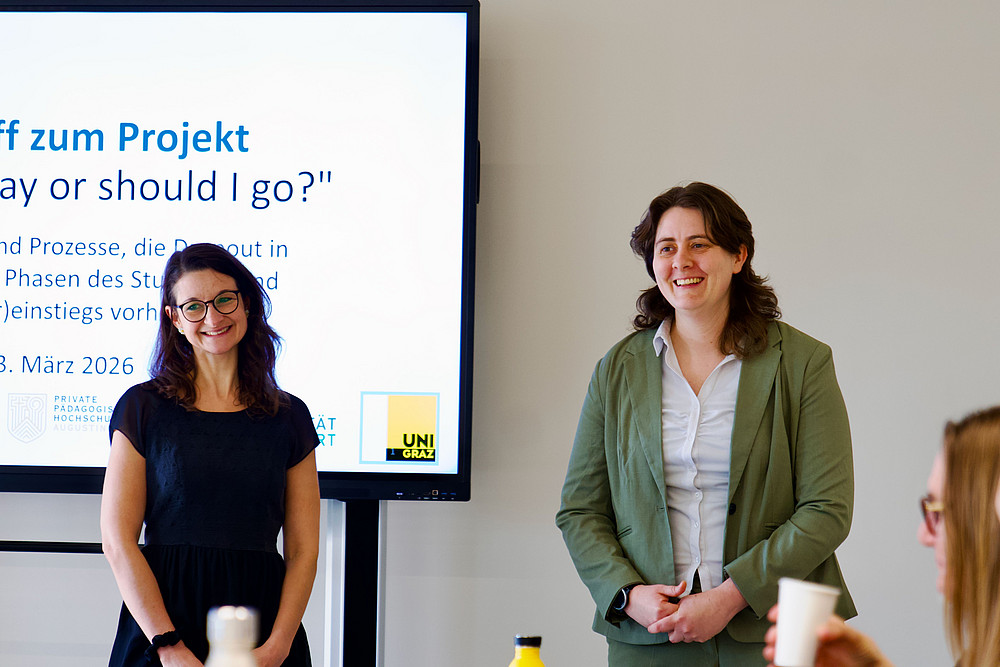
“The central question the project addresses is: ‘How can we ensure that future high-quality teachers remain in higher education and in schools?’. “This is a key issue for the future of education,” emphasises project leader Barbara Weißenbacher. Six doctoral research projects across various disciplines are exploring these questions in depth, specifically examining different stages and influencing factors on the path to becoming a teacher.
The interdisciplinary project has a total budget of 1.12 million euros, provided by the BMB and the BMFWF. The approach is comprehensive: the project examines the entire career path of prospective teachers – from admission to university through the course of study and entry into the profession, right up to long-term retention or departure from the teaching profession. The focus is on the question of how and why prospective teachers leave the profession – whether before starting their studies, during their studies, or after entering the profession. Dropping out is understood not as a one-off event, but as a multi-layered, multi-phase process in which various factors – ranging from motivation and fit to institutional conditions – play a role.
- Non-enrolment: Why do accepted applicants not start their teacher training?
- Reasons for early dropout: What role do fit, motivation and the study environment play in the first few semesters?
- Interventions: How can targeted support measures for students be developed?
- Perception of stress: Which dysfunctional patterns of experience and behaviour lead to early career exit?
- School leadership: What influence do leadership culture and working conditions have on retention in the profession?
- Career changers: Under what conditions do career changers successfully enter the profession and remain in it long-term?
The project is being carried out by an interdisciplinary consortium comprising five Austrian universities and universities of teacher education:
- University of Graz
- University of Klagenfurt
- Johannes Kepler University Linz
- University of Education Styria
- Augustinum Private University of Education
Is it the more or less suitable candidates who, after successfully completing the admission process, do not commence their studies; who drop out early or after their first teaching placement; who fail to complete their final dissertations?
Is it the more or less suitable teachers who, having completed their training, do not take up a post in a school; who move from entering the profession to leaving it; who switch careers and decide to leave again?
With “Should I stay or should I go?”, Austria is taking an important step towards better understanding the causes of the looming shortage of new teachers – and thus being able to develop targeted, effective strategies for the future of the school system.
Barbara Weißenbacher is particularly pleased “that I can once again work on a new project with many colleagues with whom I have been collaborating for a long time, and that many young, motivated people with their own ideas are joining us.”

Mag. Dr.rer.nat. Barbara Weißenbacher
+43 316 380 - 1708
Institut für Psychologie
nach Vereinbarung
https://psychologie.uni-graz.at/de/dips/team/barbara-weissenbacher/