



Awards Ceremony 2026
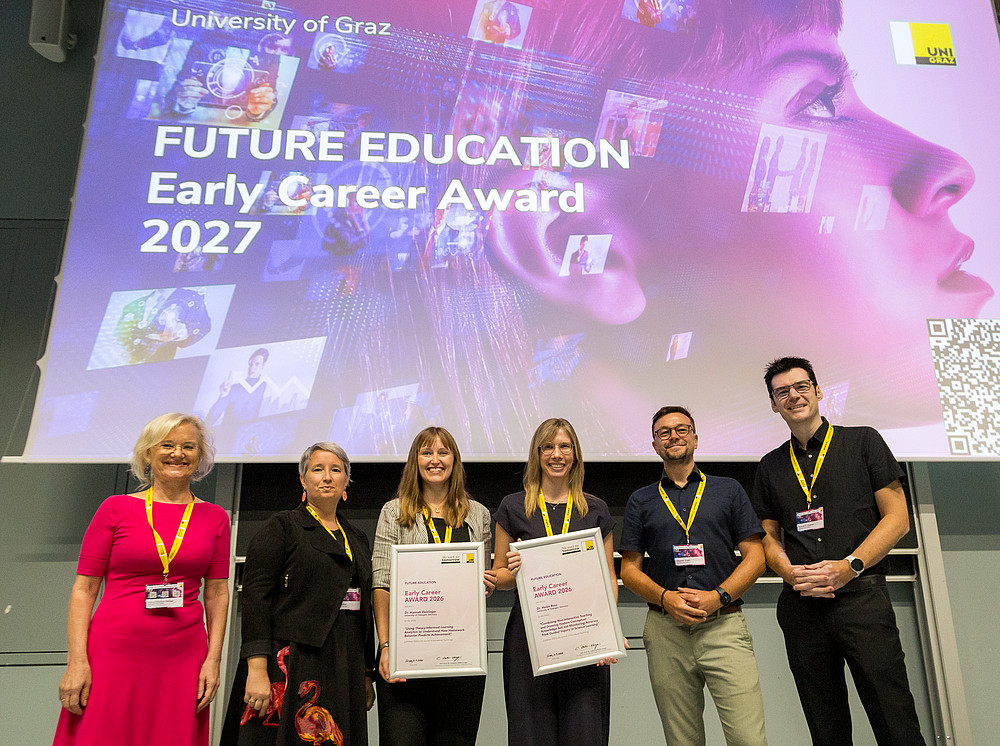
The FUTURE EDUCATION Early Career Award was presented on 2 September 2026 as part of the FUTURE EDUCATION Conference 2026 at the University of Graz to early-career female researchers who have demonstrated outstanding research achievements. Two candidates were honoured with the award this year.
Eligible submissions included papers published in a scientific journal as part of a doctoral thesis or no later than two years after the completion of the thesis. The submissions underwent a single-blind peer review process, with each paper assessed by two reviewers specialising in relevant research areas.
We warmly congratulate the two prize-winners!
Hannah Deininger
Paper: “Using Theory-Informed Learning Analytics to Understand How Homework Behaviour Predicts Achievement”
FUTURE EDUCATION Award – Educational technology(ies): interdisciplinary, innovative, disruptive
Hannah Deininger is a postdoctoral researcher at the Hector Institute for Empirical Educational Research at the University of Tübingen. Her research lies at the interface between psychology and computer science and focuses in particular on individual differences in learning behaviour, the modelling of learning processes in digital learning environments, and the analysis of multimodal behavioural data. Another focus is on the use of machine learning and explainable AI in the field of learning analytics, as well as on the conceptual underpinnings of data-driven models.
Following her Master’s degree in Psychology at the University of Ulm and a Master’s in Computing in the Humanities (Applied Computer Science) at Otto Friedrich University of Bamberg, she was awarded a PhD in Computer Science from the University of Tübingen in 2025. She has been working as a research assistant at the Hector Institute since 2021. Among other things, she is a member of the LEAD Graduate School and Research Network. Her research visits have included stints with Prof. Matt Bernacki and Prof. Jeff Greene.
- Paper: “Using Theory-Informed Learning Analytics to Understand How Homework Behaviour Predicts Achievement”, DOI: 10.1037/edu0000906
- Hannah Deininger on ORCID
Heike Russ
Paper: "Combining Non-Interactive Teaching and Drawing Fosters Conceptual Knowledge but Not Monitoring Accuracy in Guided Inquiry in Science Learning"
FUTURE EDUCATION Award 2025 – STEM+ for the sustainable development of our society
Heike Russ is a research assistant and postdoctoral researcher at the Institute of Educational Science, Department of School Pedagogy, at the Eberhard Karls University of Tübingen. She works in the department headed by Prof. Dr Thorsten Bohl, Chair of ‘Educational Science with a Focus on School Pedagogy’.
In her habilitation thesis, Heike Russ examines teaching quality, adaptivity and the management of heterogeneity within the school system. In the field of teaching and learning research, she focuses on generative learning and retrieval practice. Her research is primarily conducted within the context of authentic teaching and has a particular focus on quantitative research methods, which she supplements with qualitative analyses to enable an in-depth examination of learning processes. The aim of her work is to contribute to greater equality of opportunity and participation in the education system through evidence-based approaches.
Since October 2024, she has represented mid-career academics in school pedagogy on the Advisory Board of the Institute of Educational Science.
Heike Russ is a member of the DFG Research Group “Lasting Learning: Cognitive Mechanisms and Effective Instructional Implementation’ (FOR 5254), the Tübingen School of Education (TüSE), the Tübingen Centre for Digital Education (TüCeDE), and an associate member of the LEAD Graduate School & Research Network.
- Paper: “Combining Non-Interactive Teaching and Drawing Fosters Conceptual Knowledge but not Monitoring Accuracy from Guided Inquiry in Science Learning”, DOI: 10.1037/edu0000971
- Heike Russ on ORCID
FUTURE EDUCATION Early Career Award 2026: Call for applications, criteria & deadlines
The FUTURE EDUCATION Early Career Award 2026 recognises outstanding transdisciplinary research by early-career researchers in the fields of education, learning, development and teaching. The award will be presented at the FUTURE EDUCATION Conference 2026: Interdisciplinary Research Perspectives in Graz. A maximum of one prize, worth 1,000 euros each, will be awarded per FUTURE EDUCATION research cluster. In addition, the prize winners and their work will be featured in detail on the FUTURE EDUCATION website.
Important dates
- 10 November 2025: Start of submissions
- 22 February 2026: Submission deadline
- 1 April 2026: Registration for FEC 2026 opens
- 15 May 2026: Review results announced
- 1 June 2026: Registration deadline for FEC 2026 speakers
- 1 July 2026: Programme published
- 10 August 2026: Registration deadline for participants at FEC 2026
- 2 September 2026: Formal awards ceremony as part of the FUTURE EDUCATION Conference 2026: Interdisciplinary Research Perspectives