“AI should serve as a complement to enhance one’s own abilities, rather than replace them”
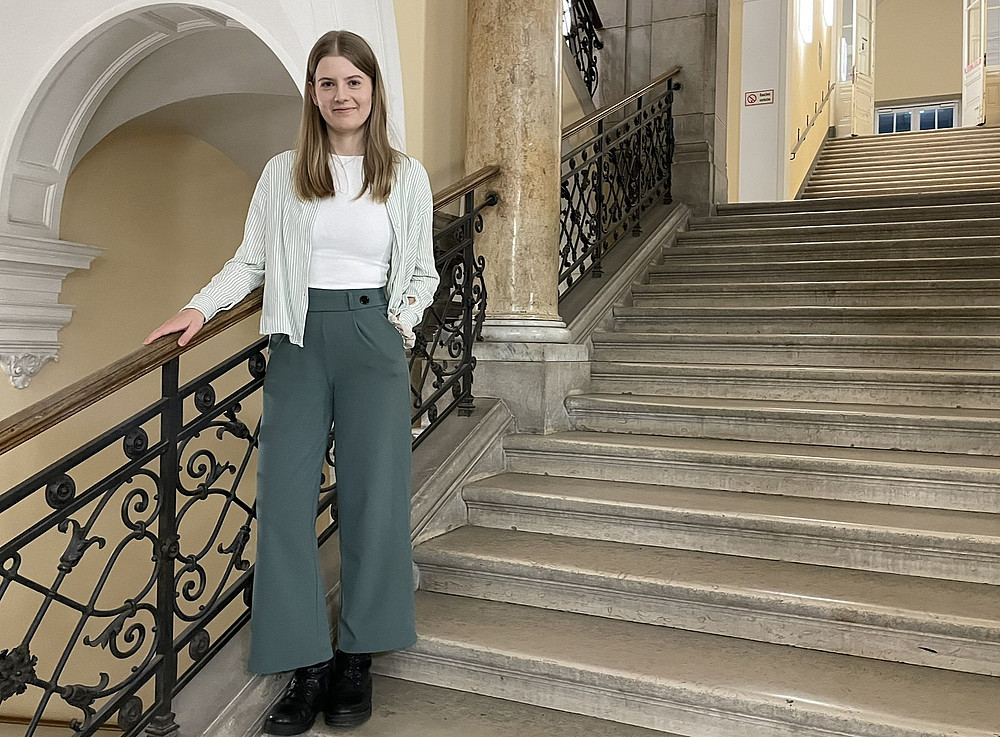
In her doctoral thesis, which lies at the intersection of psychology and computer science, Julia Pöschko is investigating learning with AI. She is analysing how educational agents – or avatars – can act as human-like learning partners to bring about lasting improvements in students’ motivation and knowledge acquisition. At FUTURE EDUCATION, she is a member of the MINT+ cluster.
Her research focuses on learning with artificial intelligence. More specifically, she investigates the use of educational agents and generative AI in digital learning environments. The focus is on virtual characters designed to support students in their learning by imparting knowledge and boosting motivation. Whilst such agents have often been limited to providing predefined answers in the past, Julia Pöschko is investigating how they can be improved using generative AI – similar to ChatGPT. The aim is for the agents to respond to learners in a more personalised and nuanced way.
“The desire to immerse myself in academia has been there for a while,” emphasises Julia Pöschko. “During your studies, you don’t get to know what everyday research is like – you only find out once you’re actually in it.” Does she like it? “It never gets boring because it’s so diverse. I also enjoy teaching. I just wish I had more time for it.” What she particularly values about the FUTURE EDUCATION research network, where she is a member of the MINT+ research cluster, is the great potential for synergies.
For ten months, she was a project assistant at the Institute of Psychology at the University of Graz, before beginning her PhD in educational psychology in October 2024 – following her two Master’s degrees in Psychology and in “Computational Social Systems” – an interdisciplinary joint degree programme run by the University of Graz and Graz University of Technology, where she learnt the fundamentals of computer science, programming and machine learning.
As a first step in her research, the Upper Austrian native is investigating avatar design. She wants to find out whether a realistic human representation or a comic-style avatar makes a difference to knowledge acquisition, as well as to variables such as trust in the agent, social presence and motivation – variables that are all important in learning.
She uses computational thinking as the specific subject matter for her studies. This is a structured problem-solving ability in which complex tasks are broken down into sub-steps and algorithms – essentially a mental step prior to the actual programming, but one that is relevant across a wide range of academic disciplines. She conducts her experiments online with a broad sample of psychology and computer science students.
However, she does not view the use of AI tools and avatars uncritically. Above all, she believes these carry the risk that the actual learning process could be pushed into the background or even take place to a lesser extent. She fears that personal reflection could be lost as a result of the work being made easier. Skills could also be sacrificed for the sake of efficiency.
She also sees particular difficulties with younger pupils, as they often lack the necessary maturity to critically question the results of AI or to handle them responsibly. “AI should therefore serve as a supplement to improve one’s own abilities, rather than replacing them,” emphasises Julia Pöschko.
What does she hope to achieve? “To create learning environments that help students develop important cognitive skills they might not otherwise learn during their regular studies,” says Julia Pöschko.